

If there’s one thing that will make a CFO or CIO wake up in cold sweats, it’s the concept of shelfware ‒ large software deployments that suck up time, money, and resources and then sit on the shelf wallowing in underutilization.
Luckily for today’s data-driven organizations, there is a proven cure that can help our financial and technology executives rest easier. A recent Aberdeen report put a spotlight on companies experiencing a high level of user satisfaction with the ease-of-use and job role relevance of their analytical solutions. Not only had these companies achieved a higher level of adoption and engagement in analytical activity, but they boasted substantial business performance improvements as well.
Ease-of-use, however, is not a switch one can just flip. It represents the culmination of healthy activities in a variety of areas of the analytical value chain. Take the analogy of someone trying to improve their physical fitness. This person might focus on core abdominal strength as an aspirational goal, but no one wakes up with a six pack after doing a few sit-ups. This requires a combination of a healthy diet, cardiovascular activity, strength training, and increased flexibility. In the same way someone with a strong abdominal core can’t help but be healthy in several other aspects of their physique, a company with high user analytical ease-of-use has likely made efforts in several other areas of their business to get to that point. According to the research, these companies share several characteristics that help them along this journey, including:
- Data maturity. Companies with high ease-of-use are more likely to expose relevant data to more users in the organization, but do so in a controlled fashion. These organizations have the ability to share data cross-functionally, but they also put in place the right capabilities around data governance and oversight. This data maturity increases the portability and usability of data without compromising its quality.
- Technology diversity. Ease-of-use with analytics isn’t about dropping an oversimplified report in front of a non-technical user. Easy and engaging solutions are powerful in their ability to capture and process data, and job-role relevant at the point of interaction. Companies with easy BI are more likely to use back-end capabilities for data management and integration, but also more likely to use technology for data exploration and interactive visualization as well.
- User-driven mentality. To the aforementioned point, ease-of-use could mean different things to different users. While some might be inclined toward pure analytical consumption of reports and dashboards, others are more interested in getting their hands dirty with the data. So how can companies tailor the solutions properly to meet this diversity of needs? For starters, they should actually listen to their users. Companies with easy BI are more likely to have processes in place to define and communicate end-user needs for analytics. They’re also more likely to have programs in place to build stronger BI capabilities in house, raising the bar of analytical curiosity across the organization.
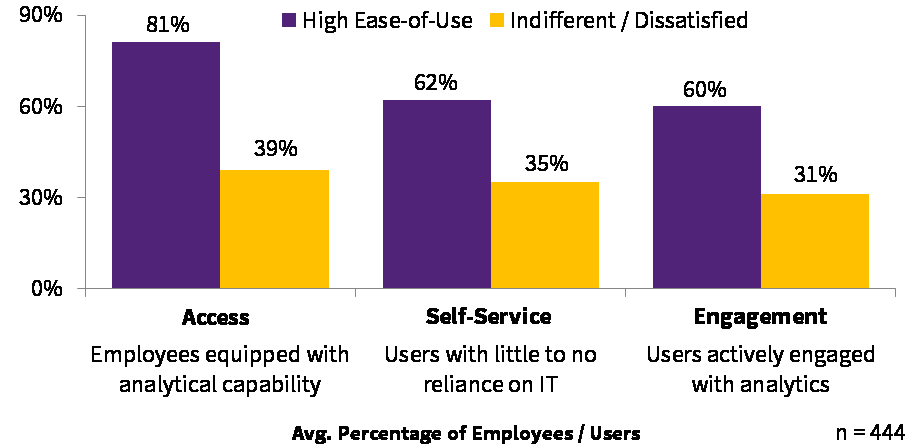
For these organizations, the hard work and user focus pays off. Companies with high ease-of-use experience greater organizational access to the BI tools they need, diminished reliance on IT when it comes to creating insight, and a higher level of analytical engagement as well (Figure 1).
Figure 1: Power to the People
Source: Aberdeen Group, May 2015
Adoption and engagement, though, carry a twofold benefit. On the one hand, higher adoption improves return on analytical investment as more users get a greater benefit out of the implementation. This more expansive use of analytics then translates to the financial statements. Aberdeen’s research shows that these companies saw enhanced organic revenue growth, and a marked reduction in operating cost as well.
As companies start to lay out their regimen of healthy analytical activities, they should keep their sights squarely focused on user empowerment through ease-of-use. Not only will this strategy help avoid the specter of BI shelfware, but it will promote happy and well-rested senior executives as well.
For more information, feel free to explore the full report here: Easy Breezy BI: Simplicity Drives Success
