

The economic shutdowns driven by the COVID-19 pandemic affected all companies worldwide. As organizations shifted to a remote work environment where feasible and many were forced to temporarily close, people found themselves staying at home with limited mobility.
This lifestyle change altered the buying habits for most consumers, who shifted to online shopping as restrictions were imposed. Virtually overnight, online ordering and home delivery / direct-to-customer orders surged at the outset of these changes. For companies supporting retail product flows, omni-channel complexity and volume increased for manufacturers, wholesale distributors, and retail DCs (distribution centers) — which, from a fulfillment perspective, put tremendous pressure on all retailers and supporting supply chain partners.
Managing Complexity with OCM
Omni-channel order management (OCM) capabilities are necessary for retailers and their supporting manufacturers / distributors to effectively manage the increased volume, complexity, and dynamic channel shifts that companies are faced with for direct-to-customer / home delivery fulfillment.
Aberdeen Research indicates that 47% of Best-in-Class companies have OCM capabilities, compared to 38% of All Others, positioning themselves in a much better position to cope with sudden changes. All businesses in 2020 faced the disruption of their inventories being in the wrong place to support fulfillment. OCM users had visibility to deal with these mismatches between demand versus inventory, without scrambling for information like non-users.
Is it Worth the Investment?
OCM users have a 94% advantage in their ability to make direct-to-customer / home delivery orders, compared to All Others who, at 36%, are not prepared to handle their omni-channel volume efficiently. Managing multiple customer channels across multiple sources requires agility and flexibility — workflow options to support the order fulfillment are:
- Retail store to customer
- Retail DC to customer
- Wholesale DC to customer
- Manufacturer DC to customer
Figure 1: Omni-channel Order Management Excels vs. Companies Without It
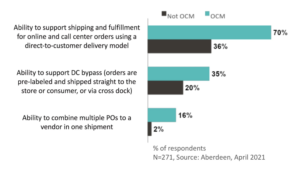
Depending on the business, OCM users also have a significant advantage in shipping direct from the source and bypassing a DC to go direct-to-customer / home delivery or direct-to-store. This flexibility enhances the ability of OCM users to serve the customer in the most efficient manner.
Combining multiple vendor orders into one shipment is another advantage that’s nearly unavailable for those without OCM and further enhances the OCM users’ capabilities to handle omni-channel complexity.
To address the omni-channel issues created by the surging direct-to-customer / home delivery orders, companies need to upgrade or pursue OCM capabilities. Aberdeen data indicates that non-users lack the capability to support omni-channel fulfillment compared to the Best-in-Class, whose approach has included adopting OCM.
The buying habits of consumers have changed in response to the shutdowns and quarantines. For retailers, distributors, and manufacturers, the direct-to-customer / home delivery fulfillment challenges for fulfillment still exist. Aberdeen recommends that all companies follow the lead of the Best-in-Class in their adoption of an OCM solution.
