

At this point, there is little doubt that wise leaders of B2B sales teams have bought into the need for a robust sales enablement strategy.
But, while investing in a relevant content management technology solution, for example, has evolved from “nice to have” into an essential operational platform, most organizations have yet to adopt the crucial process and organizational capabilities required to turn such investments into true sales enablers.
As initially revealed in Aberdeen’s Why Have ANY Hands Tied behind Your Back? And Other Rhetorical Sales Enablement Questions (February 2015), 60% of Best-in-Class companies (definition in sidebar, page 3), indicate that, “Marketing has extensive visibility into the sales team’s utilization of content / assets.” This percentage is only half as robust among under-performing firms, with 31% of Industry Average and 28% of Laggard companies indicating the same proficiency.
The data presented in this report compared both the performance and behavior of companies that have adopted this core competency, with those companies yet to understand the value of this crucial sales enablement line-of-sight capability. The recommendations based on this research focused on how companies need to make the most of their knowledge management abilities.
Let’s drill deeper into the business processes and organizational best practices necessary to bring your sales enablement investment to fruition.
Why a Clear View of Content Utilization is Essential
Why do modern B2B sales organizations need to provide their marketing team with visibility into how their content assets are deployed by their counterparts in sales? Because it’s the 21st century and that’s what the most competitive organizations are doing.
The explosion of analytical tools now applied to virtually all communications around the customer acquisition lifecycle – web behavior, e-mail content, speech analytics, etc. – provide businesses with an unprecedented amount of insight into how, when, and to what extent their content is consumed. Still, while marketing automation platforms have, for quite some time, provided their owners with this advanced degree of knowledge about their prospects and customers, only more recently has this high degree of visibility been available around understanding what the sales team is presenting to buyers in the first place.
Such knowledge is no longer a luxury; it has become an essential tool to streamlining and optimizing the messaging we put in front of our buyers.
Figure I: Better Content Deployment Visibility, Stronger Business Outcomes
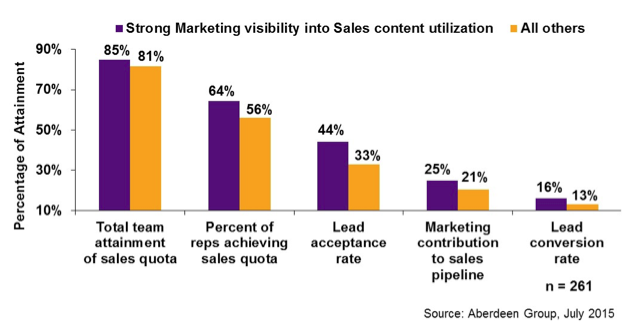
In Figure 1, we see how KPIs crucial to both marketing and sales success correlate with visibility into the use of content by sales. Not only do Best-in-Class companies lead under-performers in establishing a formal practice that enables marketing to understand, in real-time, how sales is deploying their content, adopters clearly outperform other companies around the metrics that matter.
Okay, You’ve Invested in Sales Enablement. Now What?
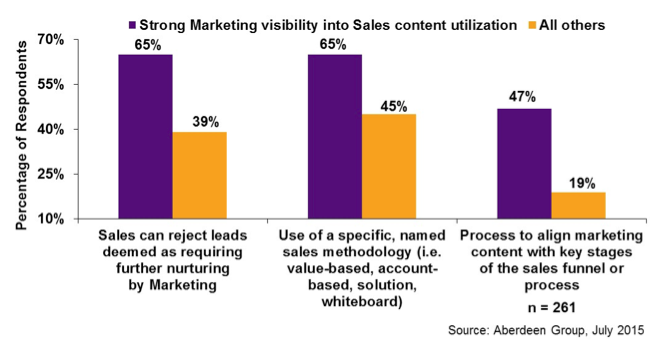
As with any complex application, turning on a B2B sales enablement engine requires an understanding of business processes and organizational best practices that need to be implemented in order for the solution to be effective. In Figure 2, we look at three process-oriented essentials that are more aggressively adopted by both Best-in-Class companies and those reporting high degrees of content deployment visibility, when compared to under-performing organizations.
Figure 2: Process Capabilities: Must-Haves for a Successful Sales Enablement Deployment
Let Sales Reject Leads
In the old days of professional selling, marketing and sales personnel collaborated less than today, and communicated less effectively regarding the most important currency shared by both teams: leads. In traditional businesses, the marketing organization would develop and toss what they considered qualified leads to sales reps, and then move on to the next campaign with little regard for how these leads were evaluated on the other side of the wall.
Modern businesses are well on their way toward a more evolved relationship, with almost half (49%) of all companies telling Aberdeen that sales can reject leads deemed as requiring further nurturing by marketing. Indeed, fully 65% of companies enjoying high content visibility use this approach right now, a level that is two-thirds higher (65% vs. 39%) than All Others.
Adopting such an iterative approach to assessing the quality of sales leads is a wise choice for marketers. This is especially true for those seeking greater collaboration with their sales counterparts, better visibility into what content is most effective, and a smarter path toward the lead acceptance and conversion rates shown in Figure 1 above.
Name Your Methodology
For generations of professional sellers, developing the perfect sales pitch represented a holy grail.
Modern companies often work with external providers to deploy ‒ or internally develop ‒ their own named sales methodologies that are designed to scale proven best practices in marketing and sales messaging for ever-larger teams of sales reps and channel partner organizations. These approaches are not intended to muzzle great B2B sales communicators, but instead to guide them to effectively sell in a way that is known to work.
In Sheldon Cooper, Sales Whisperer: Applying the Science of Data to the Art of Selling (September, 2014), Aberdeen research showed how optimized sales coaching techniques can be enhanced by a data-driven understanding of the most effective sales tactics, messaging, and content. Without a core methodology in place, enterprises have fewer standardized sales stages and deal progression milestones to analyze, and as a result, will lack the kind of visibility into content deployment that formulates the hypothesis of this report, namely, that modern sales success requires more order and process than some quota-busters are used to enduring.
Align Content to the Funnel
Speaking of milestones, Best-in-Class companies are 69% more likely than All Others (44% vs. 26%) to align marketing content with key stages of the sales funnel.
An even higher percentage of firms with high visibility into content usage (47%) take the same approach. They understand better than under-performers that “snackable” short-form marketing content – think: infographics and checklists – is more effective for early-stage sales messaging, while more robust materials – such as what you are reading right now! – are more appropriate for late-stage investigators of goods and services.
Without prescriptive messaging designed to support identified sales engagement stages, companies reporting the worst sales performance to Aberdeen are hurting themselves by either randomly creating marketing content or, even worse, not suggesting or tracking specific content use cases for the sales team.
To learn more, check out the full report.
Image Source (Creative Commons): Don O’Brien.
