

You’ve got to give it up to Hubspot. This upstart startup in Cambridge has built a dedicated and passionate fan base with an almost cult-like following centering around a movement called “inbound marketing.” This past week, at Hubspot’s annual user conference, this movement was on full display in Boston’s Seaport District. The INBOUND conference, which has now grown to over 10,000 attendees, and boasts keynote speakers like Malcolm Gladwell and Martha Stewart, is proof that inbound isn’t on the way out any time soon in terms of marketing tactics. But with all the hubbub from Hubspot’s annual event, what can we actually take away?
By now, most marketers are already well-acquainted with the term “inbound,” but like any movement worth its salt, the definition of the cause can be a matter of interpretation. Zealots will take the term quite literally, embracing a philosophy that says attention must always be earned; you can never pay for it. Others, and I think most marketers, will take a more pragmatic view that inbound marketing represents something of a new compact with the customer. To me, it’s a philosophy that says your marketing must be worthy of your buyer’s attention, regardless of how that attention was achieved. The numbers around inbound marketing captured in Aberdeen’s demand generation / marketing automation and content marketing research seem to support this notion.
Adoption of Inbound
When asked to provide an estimate of their inbound vs. outbound lead generation (based on 1st touch), the largest percentage of companies in Aberdeen’s marketing automation research indicate a mix of 80% outbound and 20% inbound. When we take a weighted average, the ratio is 55.5% outbound and 45.5% inbound, and for Best-in-Class companies it’s 60% outbound and 40% inbound (i.e. Best-in-Class companies report a mix more heavily weighted towards outbound). However, Aberdeen’s content marketing research shows that leads generated through content marketing (an approximate, but not exact, proxy for “inbound”) are seen as higher quality by Best-in-Class firms, with 53% of Best-in-Class companies saying they convert at a higher rate, compared with 33% of All Other companies making this claim. Putting this together suggests that from a yield perspective, content-based inbound marketing may generate as much or more revenue-generating marketing activity even if it’s lower in terms of the top of funnel mix.
Outbound/Inbound Mix by Performance Class
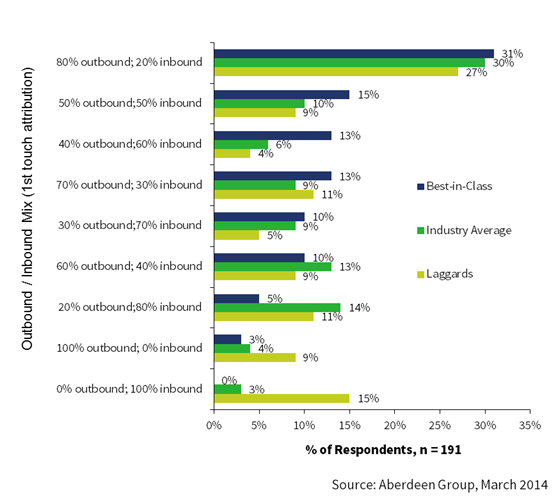
It’s interesting to note that Laggard companies (the bottom 30% of performers) are more likely to be at the extremes, while Best-in-Class companies tend to take a more balanced approach. Regardless of the exact percentages here, the conversations I’m having with B2B marketing leaders makes it clear that the inbound movement is with us, and the high degree of interest that firms have in increasing the share of inbound leads (while keeping the lights on).
Back at INBOUND
Not to get too meta, but the proof of this statement can be found in the success of Hubspot’s INBOUND conference and interest in the inbound concept, which, while Hubspot focuses on small and mid-market companies, has even the most enterprise-minded marketers examining their tactics. But not content with marketing, Hubspot has also started targeting the Sales role, launching Signals a year ago, and unveiling a freemium CRM product at this year’s event. Hubspot CRM will be targeted at the segment of the market not currently using a CRM, and should help Hubspot’s SMB customers adopt integrated sales and marketing practices, a Best-in-Class trend based on Aberdeen’s research.
What’s your opinion of the inbound “movement?” Is it a natural progression, a sizable disruption, or something else entirely? Share your thoughts in the comments below.
