

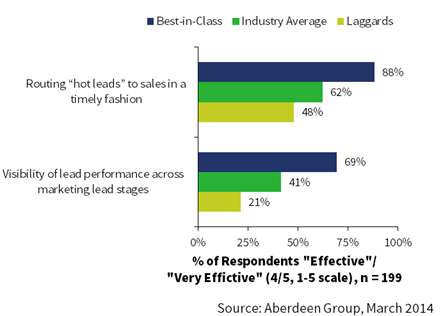
When asked to rank the value of various demand generation and lead management activities on a scale of one-to-five (one being least valuable, five being most valuable), “routing hot leads to sales in a timely fashion” is near the top of the value list, with 87% of companies Aberdeen surveyed for our Demand Generation study (199 respondents collected in March 2014). But that number is even higher for Best-in-Class companies, the top-performing companies in our study identify by conversion rates and marketing’s contribution to sales and revenue. Ninety-five percent (95%) of Best-in-Class firms rated routing of “hot leads” as a four or five on that scale. Furthermore, and more importantly, when we ask respondents about their ability to execute these activities (rank effectiveness of execution on a one-to-five scale, one being not effective, five being highly effective), the highest percentage of top-performing firms said they’re effective or very effective at routing of “hot leads” to sales (four or five on that scale). Additionally, this activity saw one of the biggest execution gaps between top-performing companies and all others.
All of this means that not only is the ability to identify a so called “sales ready” opportunity prized by all companies, and Best-in-Class companies in particular, but the ability to actually do so correlates strongly with marketing performance. So why is something that everyone agrees is such a good idea so apparently difficult for companies to get right?
The answer to this question is ultimately the answer of competitive differentiation. Competitive advantage does necessarily (or only) come from defensible technological advantages, but by building on systems of competencies that are mutually reinforced. Aberdeen’s forthcoming State of Marketing Automation 2014 report (expected to publish in August 2014) will show that adoption of marketing automation platform (MAP) functionality is predicated on sound lead management processes, well-defined lead stages, visibility of lead performance, and common definition of lead qualification criteria between marketing and sales. My colleague Maribeth Ross proposes a framework for defining lead stages in her April 2014 report Marketing & Sales Performance: The Roadmap to Revenue & Its Tollgates.
So while getting sales ready leads into the hands of sales sounds like a no-brainer, it’s a capability that depends on a solid foundation to get right. First, you need to understand what “hot” looks like for leads. In other words, some form of lead scoring needs to be in place. Is hottness based on the profile of the buyer? Is it based on recency of marketing activity, such as a download? Some kind of analytical model? 3rd party data? Some or all of the above? Getting this right will significantly impact the second capability of passing the lead to sales for follow up. Too many false positives may undermine the urgency of actioning the leads. A history of unqualified lead hand off from marketing can permanently impact action rates by sales in a kind of marketing boy who cried hot lead wolf scenario. Finally, as most modern marketers know, “hot leads” don’t just happen, they’re created. This reality is underlined by the fact that developing a volume of compelling content is the top demand generation challenge cited by survey respondents. Hot leads are forged in the crucible of content-driven lead nurturing.
So as simple as it may sound and contrary to my link bait title, responding to “hot leads” in a timely fashion isn’t just one thing, it’s the culmination of multiple things done well. Once mastered, the results are clearly hot.
