

“I can’t hit my number if I have to work inside this antiquated, bloated CRM!” Too often, the technology platforms supporting modern sales professionals serve as a handy lightning-rod for under-performance, but in reality, the breakdown occurs not in which CRM is deployed, but how it is structured, integrated, and supported with optimized sales processes and workflows. A new Research Report reveals how Best-in-Class companies enable their sellers with intelligent automation solutions, smart sales enablement integrations, leading-edge business workflow processes, and peer-ratified best practices that help companies remove sales friction – from lead to close.
Whether your organization is supported primarily by traditional inside sales reps soliciting net-new business, account managers in need of renewals or up-sells, or channel partners hoping to improve their share of a territorial wallet, at some point it’s likely that a sizeable number of your quota-carriers will need to get on the phone, prioritize their outreach, and hit their number through multiple paths of least sales resistance. Moreover, in the competitive, high-velocity, variably compensated universe in which B2B reps live, every minute not directly spent in pursuit of those deals most likely to close, represents an unwelcome opportunity to fall behind their peers and further away from hitting that all-important number. As a result, sales enterprises of all sizes and shapes continuously invest in – and often rip-and-replace – CRM platforms, hoping that the perfect technology solution will seamlessly be over-stocked with superbly qualified marketing leads, allowing their front-line sellers to do one thing: close deals.
Sales Don’t Happen in a Vacuum
Given this idealistic scenario, it is tempting for a contemporary sales leader to build a narrow fence around their team, deploy a sales-centric CRM, and then point a finger at their marketing counterparts for not producing enough qualified leads to yield all-green pipeline dashboards in the CRM-produced sales forecast. In reality, however, the more evolved and successful leaders of today’s most effective sales teams are far more collaborative with the marketing folks – see Sales and Marketing Alignment: A Primer on Successful Collaboration – and increasingly willing to open up the CRM to customer-centric processes, marketing automation data integrations, and supplemental sales enablement solutions that provide better guidance to closers throughout the entire prospect-to-customer experience.
Indeed, Aberdeen research published in Marketing-Led Teleprospecting Activities Drive Inside Sales Effectiveness tells a more holistic story around the modern sales leader, which is aptly clarified by Figure 1, showcasing the top-five strategic actions that inside sales and operational leaders indicate as most significant to their ability to beat quota:
Figure I: Top Inside Sales Business Strategies: A Laser Focus on Identifying and Converting Optimized Opportunities

In a competitive marketplace, finding a path toward a larger pipeline, connecting more efficiently with a “right message, right time, right prospect” sales methodology, and developing more nurturable opportunities are activities worthy of attention from both marketing and inside sales leaders, as well as eventual technology investments their companies consider to support them. Of interest in Figure 1, too, is a top-five strategy around improving sales activity profitability. Aberdeen’s Sales Acceleration for Winners: Best-in-Class Practices for Sales Contracting and Quoting actually found that improving corporate margins is the top goal among survey respondents in sales management roles, a marked reversal of the traditional sales persona focus on merely selling more product, with little regard for profit.
In order to run a profitable sales operation and connect it effectively with marketing engines designed to capture, distribute, guide, and prioritize the most closeable leads, Best-in-Class companies in Aberdeen’s State of Marketing Automation 2014: Processes that Produce are far more likely to invest in lead development and messaging platforms that capture, de-dupe, and distribute leads to their eager counterparts in sales – Figure 2.
Figure 2: Best-in-Class Lead Management: Better Process, Full Automation
Here, we see the dramatic deltas between top performers and under-achieving companies in their divergent survey answer options (1 or 5 on a 1-5 scale) around deploying processes and technologies that more effectively tee up the activities of B2B sales teams. These investments and best practices do not live in a marketing operations vacuum, however; the Sales / Marketing alignment research yields multiple data findings supporting the active involvement of sales leaders and sales operations practitioners in marketing activities. Best-in-Class firms, in fact, nominate attainment of overall sales quota, accelerating the sales cycle, and revenue growth from net-new accounts among their top four metrics utilized to evaluate their own marketing effectiveness. It’s no wonder that 77% of the Best-in-Class report having invested in a good or outstanding relationship between the two lines of business, compared with 56% among Industry Average and 47% for Laggard firms.
The Devil is in the Details: Executing on the Acceleration Strategy
With better practices and automation platforms in hand to create a larger, more efficient flow of marketing-qualified leads to the sales team, how do Best-in-Class companies then take the hand-off and guide their sellers toward the most effective, profitable activities? According to the Sales Acceleration research results, they take definitive measures around not leaving success to chance. In addition to better organization of content used to support the leads they’ve provided – Best-in-Class firms are 69% more likely than All Others to queue marketing materials around specific products associated with leads they develop – top-performing sales leaders improved their lead conversion and other metrics by going digital. The research also goes on to show that the Best-in-Class lead under-performers by a 46% margin (67% vs. 46%) in documenting every customer touch throughout their journey, in order to more accurately understand their engagement and buying potential at each successive step along the way. This finding is ratified by research published in Customer Engagement Has Evolved. Can Your Sales Team Keep Up?, which addresses the currently popular concept around the “demise of the sales cycle… long live the buyer’s cycle.”
Full details are available here in this free Aberdeen report.
 “I can’t hit my number if I have to work inside this antiquated, bloated CRM!” Too often, the technology platforms supporting modern sales professionals serve as a handy lightning-rod for under-performance, but in reality, the breakdown occurs not in which CRM is deployed, but how it is structured, integrated, and supported with optimized sales processes and workflows. A new Research Report reveals how Best-in-Class companies enable their sellers with intelligent automation solutions, smart sales enablement integrations, leading-edge business workflow processes, and peer-ratified best practices that help companies remove sales friction – from lead to close.
Whether your organization is supported primarily by traditional inside sales reps soliciting net-new business, account managers in need of renewals or up-sells, or channel partners hoping to improve their share of a territorial wallet, at some point it’s likely that a sizeable number of your quota-carriers will need to get on the phone, prioritize their outreach, and hit their number through multiple paths of least sales resistance. Moreover, in the competitive, high-velocity, variably compensated universe in which B2B reps live, every minute not directly spent in pursuit of those deals most likely to close, represents an unwelcome opportunity to fall behind their peers and further away from hitting that all-important number. As a result, sales enterprises of all sizes and shapes continuously invest in – and often rip-and-replace – CRM platforms, hoping that the perfect technology solution will seamlessly be over-stocked with superbly qualified marketing leads, allowing their front-line sellers to do one thing: close deals.
Sales Don’t Happen in a Vacuum
Given this idealistic scenario, it is tempting for a contemporary sales leader to build a narrow fence around their team, deploy a sales-centric CRM, and then point a finger at their marketing counterparts for not producing enough qualified leads to yield all-green pipeline dashboards in the CRM-produced sales forecast. In reality, however, the more evolved and successful leaders of today’s most effective sales teams are far more collaborative with the marketing folks – see Sales and Marketing Alignment: A Primer on Successful Collaboration – and increasingly willing to open up the CRM to customer-centric processes, marketing automation data integrations, and supplemental sales enablement solutions that provide better guidance to closers throughout the entire prospect-to-customer experience.
Indeed, Aberdeen research published in Marketing-Led Teleprospecting Activities Drive Inside Sales Effectiveness tells a more holistic story around the modern sales leader, which is aptly clarified by Figure 1, showcasing the top-five strategic actions that inside sales and operational leaders indicate as most significant to their ability to beat quota:
Figure I: Top Inside Sales Business Strategies: A Laser Focus on Identifying and Converting Optimized Opportunities
In a competitive marketplace, finding a path toward a larger pipeline, connecting more efficiently with a “right message, right time, right prospect” sales methodology, and developing more nurturable opportunities are activities worthy of attention from both marketing and inside sales leaders, as well as eventual technology investments their companies consider to support them. Of interest in Figure 1, too, is a top-five strategy around improving sales activity profitability. Aberdeen’s Sales Acceleration for Winners: Best-in-Class Practices for Sales Contracting and Quoting actually found that improving corporate margins is the top goal among survey respondents in sales management roles, a marked reversal of the traditional sales persona focus on merely selling more product, with little regard for profit.
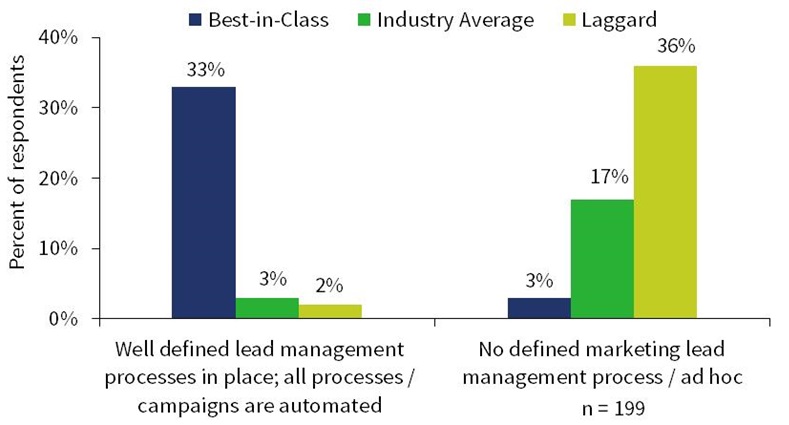
In order to run a profitable sales operation and connect it effectively with marketing engines designed to capture, distribute, guide, and prioritize the most closeable leads, Best-in-Class companies in Aberdeen’s State of Marketing Automation 2014: Processes that Produce are far more likely to invest in lead development and messaging platforms that capture, de-dupe, and distribute leads to their eager counterparts in sales – Figure 2.
Figure 2: Best-in-Class Lead Management: Better Process, Full Automation
Here, we see the dramatic deltas between top performers and under-achieving companies in their divergent survey answer options (1 or 5 on a 1-5 scale) around deploying processes and technologies that more effectively tee up the activities of B2B sales teams. These investments and best practices do not live in a marketing operations vacuum, however; the Sales / Marketing alignment research yields multiple data findings supporting the active involvement of sales leaders and sales operations practitioners in marketing activities. Best-in-Class firms, in fact, nominate attainment of overall sales quota, accelerating the sales cycle, and revenue growth from net-new accounts among their top four metrics utilized to evaluate their own marketing effectiveness. It’s no wonder that 77% of the Best-in-Class report having invested in a good or outstanding relationship between the two lines of business, compared with 56% among Industry Average and 47% for Laggard firms.
The Devil is in the Details: Executing on the Acceleration Strategy
With better practices and automation platforms in hand to create a larger, more efficient flow of marketing-qualified leads to the sales team, how do Best-in-Class companies then take the hand-off and guide their sellers toward the most effective, profitable activities? According to the Sales Acceleration research results, they take definitive measures around not leaving success to chance. In addition to better organization of content used to support the leads they’ve provided – Best-in-Class firms are 69% more likely than All Others to queue marketing materials around specific products associated with leads they develop – top-performing sales leaders improved their lead conversion and other metrics by going digital. The research also goes on to show that the Best-in-Class lead under-performers by a 46% margin (67% vs. 46%) in documenting every customer touch throughout their journey, in order to more accurately understand their engagement and buying potential at each successive step along the way. This finding is ratified by research published in Customer Engagement Has Evolved. Can Your Sales Team Keep Up?, which addresses the currently popular concept around the “demise of the sales cycle… long live the buyer’s cycle.”
Full details are available here in this free Aberdeen report.
