
Companies take varying paths when it comes to Operational Excellence, depending on their size, which leaves a lot of room for interpretation in the approaches that can be taken. For more than 50 years, Lean manufacturing has been the most widely adopted methodology (regardless of company size) to reduce cost, increase productivity, and ultimately gain a competitive advantage in the marketplace.
Lean Manufacturing is one of those methodologies that, in order to create positive outcomes and increased effectiveness across the organization, requires the right plan prior to launch, and the proper support to continue growth. The use of Lean is particularly relevant in industries where decreasing costs, improving quality, and reducing time to market are critical to success, which covers most of them if we’re being honest.
To that end, a recent Aberdeen report explores how top lean manufacturers use visibility into their operations, executive sponsorship, and automation to take their continuous improvement efforts to the next level. They all understand that the focus of lean is on forming a culture of continuous improvement that empowers workers to reduce the materials, quantity of time, and investment needed for attaining customer desires. Essentially, the goal is to sustain or increase value with less work, as waste costs you money.
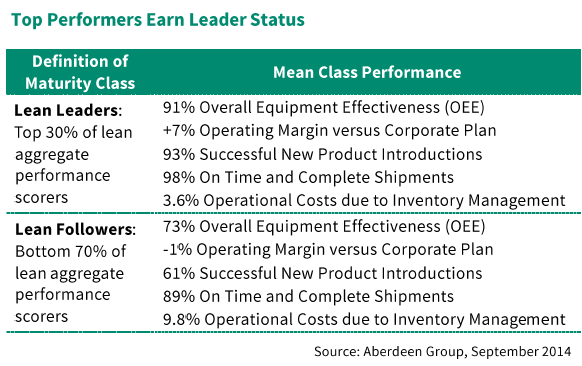
Performance on the five metrics above is directly related to an organization’s lean endeavors. OEE, as one of the most commonly used KPIs to monitor those efforts, makes for an obvious advantage among the leaders in this area.
Ultimately, lean can have many strategic elements to it, whether that comes in the form of a continuous change procedure, or a set of tools, what many companies fail to realize is that Lean should be viewed as a philosophy first and foremost. Proactively measuring, automating, and gaining increased visibility into your processes is crucial to success when adopting the Lean methodology.
