
Think succession planning is just for family businesses? Think again. Specifically, think about what happens to your organization if your innovative CTO gets lured away, or if your vibrant CMO decides to take a sabbatical. Will the team survive? Will your company lose valuable ground to competitors without their leadership? These are scary risks to consider.
Succession planning was created to mitigate those risks. It is the process companies use to determine what roles are vital to the organization and plan for future replacements if those roles end up vacant. There are many factors that contribute to a shortage in the quality and quantity of leadership – the mass departure of the baby boomer generation, competitive recruitment and the changes of the business landscape as a whole. However, organizations that commit to succession planning are better able to handle inevitable transitions in leadership without losing their ability to execute on key strategic initiatives in both the near and long term.
Simply asking department heads for a “next in line” list isn’t enough to architect an effective succession plan. Instead you need to outline the scope of your program – are you only going to focus on top leadership or do you need to ensure that critical team responsibilities are manned at all times? From there, you can embark on a true talent management and succession planning project – one that will yield significant benefits over time.
Here are a few things to consider as you move into the planning stage:
Alignment
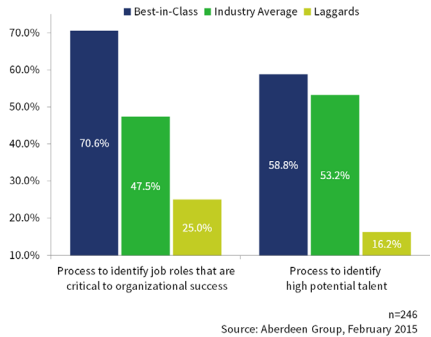
In truth, succession planning begins with an understanding of your business strategy and knowing what skills are needed to ensure your success. Mapping requirements to key positions is a proven way to help team leaders and senior management identify and groom employees with high potential for specific roles. In fact, Best-in-Class talent planners are 81% more likely to have a process in place for identifying job roles that are critical to organizational success.
Continuously Align with Changing Requirements: Companies today evolve very quickly to keep up with changing market and customer demands. It is critical that a company’s talent management plan evolve just as quickly if a company hopes to keep pace. Best-in-Class organizations recognize this and continuously align their human capital management strategy with the changing strategy of the business as a whole.
Best-in-Class Organizations Excel at Alignment and Agility
Visibility & Transparency
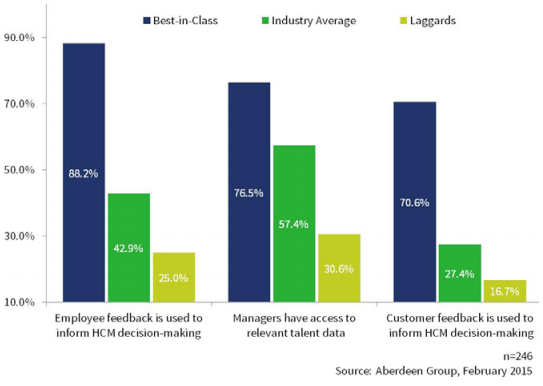
Too often, talent remains siloed within specific departments. Unfortunately, a lack of cross-organizational visibility may actually hinder your succession planning efforts. After all, your next CMO may be toiling away in R&D and your next head of product management may be solving key customer support issues. Finding a way to bring high potential talent to the attention of all team leaders is critical not only for succession planning, but also for optimizing external talent recruitment efforts.
Often, technology is your best bet in breaking down these barriers. Consider using software tools to create a repository of talent profiles and track talent across the organization as a whole.
Access to Feedback and Data Defines Best-in-Class Transparency
Create a Visibility Matrix: Organize a list of the top 50 high potential employees. Categorize how well senior leaders know those employees. This way you can clearly see the individuals who are more or less visible within the company and use the information to understand where talent pools exists and enhance cross-organizational talent sharing activities.
Accountability
As with any annual HR program, holding leaders accountable is critical to the ongoing success of any succession planning initiative. It is easy to write up a plan but organizations tend to fall short on follow-through – updating it and ensuring that it is actually used in the event a position of value opens up. Even high-performance organization struggle with this. Just under 50% of those companies believe that not holding their leaders accountable was a major hindrance to their ability to accelerate development of leaders in their organizations.
Aggregate Talent Data: Developing a list of the strengths, weaknesses and proposed action plans for all successors enables leaders to keep track of all employees and see how they are doing in their current position. More importantly, it will help you as an HR professional spot corporate wide trends – maybe 36% of your mid-level managers lack people development skills or 47% of employees fail to manage time properly. Address these deficiencies on a corporate level to increase the efficiency and ROI of key organizational development and learning initiatives.
As you nurture and develop talented individuals in your organization, it can be difficult to think that someday they might leave the company. Regrettably, that is a reality. Preparing for those eventualities through succession planning will help your organization come out the other side prepared to move forward.
Need more details? Download the latest Aberdeen report on the subject, How a Lack of Alignment can Kill your Succession Planning Efforts.
