

The whole idea behind the term “human capital” is that the employees your organization hires and develops are a valuable capital to the overall company. Clearly then, when it comes to establishing a strong leadership pipeline, organizations need to look at their existing, internal assets – in addition to external candidates.
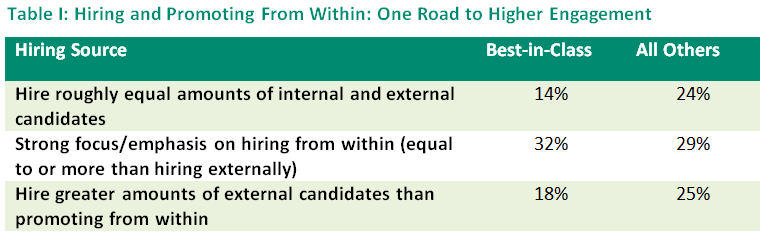
Ultimately, talent acquisition and career development / succession tools answer the same essential question: “where can I find the best person to fill this role?” But given the continued shortages of key skills available in the marketplace, many organizations will not be able to simply buy their way out of their leadership talent shortages — they must also build from within. In fact, one-third of Best-in-Class organizations place an emphasis on hiring from within that is equal to or greater than from hiring externally. They recognize the value of developing the talent they already have and capitalizing on the valuable institutional knowledge of their workforce.
Why Is Internal Recruitment So Important?
Placing an equal emphasis on hiring from within to hiring externally signals to your employees that you recognize their contributions and that you are committed to their growth and development. This commitment is one very likely factor contributing to the significantly higher numbers of employees who say they are “highly” engaged at Best-in-Class companies (87% vs. 53% of All Others).
Retaining a workforce is important for many reasons. For one, it can keep the company’s culture, core competencies and ability to achieve a strategic advantage in tact while still allowing them to grow and evolve. Second, recruiting and developing an internal workforce can prove to be a much more cost effective way for companies to fill their more valued roles within the company without paying the burdensome costs of losing one employee and bringing in a new one.
By using an internal recruitment process, companies can more effectively identify and attract capable applicants within the company itself in order to retain them and get them into positions where they can use their experience and skill sets to benefit the corporation further – a clear advantage for any company.
How to Build an Internal Hire Environment
Understanding what employees’ value internally about their workplaces can help employers to further understand how to create an environment in which their employees will become satisfied with the work they do, be committed to the organization and want to go above and beyond what is expected of them (discretionary behavior) – most of which are facets closely linked to employee engagement.
A seminal study by management researcher Mark Huselid studied the many facets of internal equity and how it is positively related to job satisfaction over and above any factors related to external equity such as salary. The most important elements that influence employee satisfaction and decisions on their status in the workplace, included raises, fringe benefits, promotions, incentives, salary, and recognition. All of these create perceptions of internal equity and so too can be used as elements that would be utilized within the internal recruiting process, particularly recognition, promotion, and salary.
These results indicate that when a part of the organization, an employee does value the promotion opportunities and ability to increase their earning potential as motivating factors, both of which can be enhanced through adjustment of the internal recruitment process and its operation. From the external equity perspective, employees consider the kind of recognition they receive and frequency or amount of raises they are granted in comparison to the labor market.
The results also cue the idea that the internal recruitment process must be based on satisfying the lower level needs (salary) and higher level needs (promotion, recognition) in order to keep employees satisfied in the workplace, thus increasing the chances of retaining that employee/reducing turnover.
Once a company can understand what factors of an internal recruitment policy are necessary and effective as creating a sense of equity, they can construct a policy that will more likely create satisfaction in the workplace and thus hopefully help retain the workforce, which can truly benefit an organization.
References:
Huselid, M. (1995). Perceptions of Internal Recruitment Processes as Predictors of Employee Satisfaction. Academy of Management Journal, 15(2) 33-46.
