

The fundamental shift of replacing mechanical functions with hardware and software has been the driving force behind the field of mechatronics. As a way to address market demands for more complex products, mechatronics engineering is used to integrate mechanical, electrical, and software components.
In the past, each part was designed in a vacuum where product development occurred in a sequential fashion. It was a method that rarely worked without error. Missed deadlines and budget overshoots caused companies to start streamlining their processes by using a development method that forced a more collaborative approach of all disciplines throughout the entire design cycle.
Collaboration is Necessary
In mechatronics engineering, the principles of mechanics, electronics, and computing are united to create an economic, functionally complex system. The challenge lies in incorporating these systems effectively such that no information is lost in the data exchange. In a recent survey conducted by the Aberdeen Group, the top two challenges for product development listed by survey respondents were collaboration (39%) and disconnected processes (30%).
Notably, 18% of all respondents said data quality was one of their top challenges. The focus on data quality will grow as operational sites become increasingly global. And when compared to the previous year, only 24% of companies said collaboration was a top challenge.
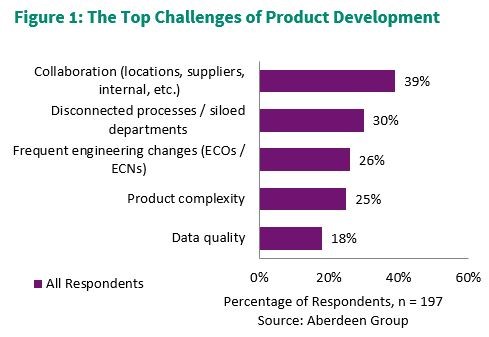
That’s a 15% increase year-to-year. As product complexity and engineering disciplines tightly integrate, the weight of meaningful collaboration will become increasingly critical to the successful design and deployment of a product.
Guidelines for Effective Collaboration in Mechatronics Product Development
Effective incorporation of different functions in a mechatronics product means a collaborative effort by all designers. The exchange of data must be done smoothly and with automation. In order to do so, the process that facilitates cross-discipline collaboration and synchronization must be mastered. Specific guidelines companies should follow for mechatronics product success are:
- Centralize hardware and software resources such that they are widely accessible to all stakeholders. Provide a single repository for all product development data. This ensures the most current version is used for any development decisions or manufacturing requirements. Centralization is a widely used practice as 52% of survey respondents provide controlled access to software and hardware resources.
- Create one unified product definition for all disciplines at the start of the project. It’s important to approach complex mechatronics systems in a holistic manner. This enables designers to engineer their parts with the same goals in mind. Best practice is to use a collaborative mechatronics solution that synchronizes development processes across all disciplines.
- Centralize data storage and manage revision control in one vault. Single location, user-controlled access to data ensures the correct version of every file is being used. It also provides all stakeholders with the most current information so that changes are not made to outdated designs. Best-in-Class are 57% more likely to have centralized access to change history than All Others.
For more on this subject, check out the full report.
